
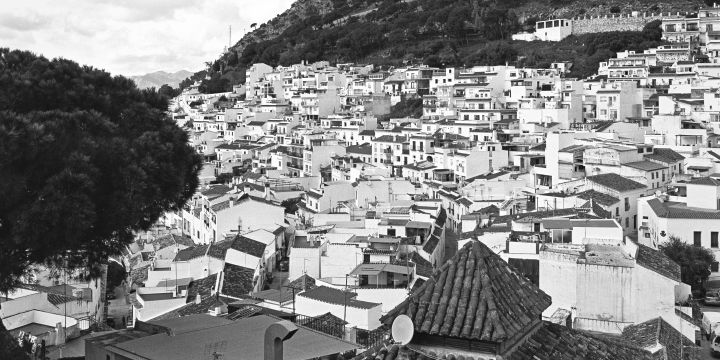
Perched in the foothills of the Sierra de Mijas, Mijas Pueblo is one of the most picturesque white villages in southern Spain. Known for its dazzling whitewashed houses, narrow cobbled streets, and sweeping views of the Costa del Sol, this charming village offers a perfect blend of traditional Andalusian culture and relaxed Mediterranean living.
Despite its popularity among visitors, Mijas Pueblo has retained an authentic atmosphere, where locals still gather in small plazas and daily life unfolds at an unhurried pace.
Key Landmarks
Ermita de la Virgen de la Peña
The Ermita de la Virgen de la Peña—a small chapel carved directly into the rock—reflect the area’s deep cultural and religious roots. Nearby, the scenic viewpoints offer breathtaking panoramas stretching across the coastline, especially at sunset when the landscape glows in warm golden tones.

Camera: Nikon F3, Lens: Nikkor f2 35mm, Exposure: 1/125 sec, Aperture: f11, GPS location
Iglesia de San Sebastián
The Iglesia de San Sebastián, one of Mijas Pueblo’s oldest and most historically significant religious buildings, dates back to the late 17th century. Originally a small hermitage dedicated to Saint Sebastian, a protector against plagues and epidemics, it reflects the religious devotion and fears of disease prevalent in that era. Many Andalusian communities built chapels in his honour.
Initially modest, serving as a simple chapel for local residents beyond the village centre, the hermitage evolved as Mijas Pueblo grew. It was expanded and adapted, eventually becoming a prominent place of worship. Today, its architecture showcases a blend of original structure and later additions, incorporating traditional Andalusian elements.
A key feature is its façade, featuring a small bell gable and a niche with an image of Saint Sebastian. Inside, religious artwork and devotional objects underscore the enduring significance of Catholic traditions in the region. While simpler than larger churches, its charm lies in its intimacy and historical continuity.

Camera: Mamiya C220, Lens: Mamiya Sekor 3.5 65mm, Exposure: 1/125 sec, Aperture: f11, GPS location

Camera: Mamiya C220, Lens: Mamiya Sekor 3.5 65mm, Exposure: 1/125 sec, Aperture: f11, GPS location
Iglesia Inmaculada Concepción
The Iglesia de la Inmaculada Concepción is the main parish church of Mijas Pueblo, and its history closely reflects the transformation of the village itself from a Muslim settlement into a Christian town.
After the Christian conquest of Mijas in the late 15th century, the Muslim population was expelled, and Christian settlers repopulated the area. To serve their needs, the parish of the Inmaculada Concepción was established in the 1490s.
The current church building was constructed in the mid-16th century (around 1540–1565) under Bishop Bernardo Manrique. It was built on the highest part of the village, within the old fortified area, incorporating elements of earlier structures. The church was completed and consecrated in 1631.
Architecturally, the church reflects Andalusian styles of the time, with three naves, a wooden Mudéjar-style roof in the central aisle, and later Baroque additions in its chapels. Its bell tower was originally part of a defensive structure called the Torre de la Vela, used to watch for coastal threats.
For centuries, the church served as a burial place, with crypts beneath the floor. This practice continued until the late 18th century, when burials were moved to an adjacent cemetery.

Camera: Mamiya C220, Lens: Mamiya Sekor 3.5 65mm, Exposure: 1/125 sec, Aperture: f8, GPS location
The Bullring
The Plaza de Toros de Mijas stands out because it breaks one of the main conventions of bullring design: it is oval rather than perfectly circular. Most bullrings across Spain are round, following a traditional layout that dates back centuries. Mijas’s unusual shape immediately catches the eye and is the main reason it looks so different.

Camera: Nikon F3, Lens: Nikkor f1.8 50mm pancake, Exposure: 1/250 sec, Aperture: f11, GPS location
This distinctive design wasn’t purely aesthetic—it was largely a result of practical constraints. Built in 1900, the bullring had to fit into a limited space on the edge of Mijas Pueblo, perched along the hillside with existing buildings nearby. Instead of reshaping the terrain extensively, the builders adapted the structure to the available land, resulting in its unique oval form.

Camera: Mamiya C220, Lens: Mamiya Sekor 3.5 65mm, Exposure: 1/125 sec, Aperture: f11, GPS location
In addition to its shape, the bullring is relatively small and intimate, with just one main tier of seating. This gives it a more personal, village-scale feel compared to the grand arenas found in larger cities. Its whitewashed exterior also blends seamlessly with the surrounding architecture of Mijas Pueblo, making it feel like a natural extension of the village rather than a monumental standalone structure.
Arts and Crafts
Mijas Pueblo is especially well known for its rich artisan heritage, where traditional Andalusian crafts are still actively practised and sold in small workshops and markets. The village has even been officially recognised as an “Artisanal Interest Zone,” highlighting the importance of its craftsmanship and the preservation of traditional techniques.
One of the most iconic crafts in Mijas Pueblo is ceramics and pottery. Visitors will find colourful plates, bowls, tiles, and decorative pieces featuring classic Andalusian designs—often in vivid blues and greens. These items are typically handmade using age-old methods, making each piece unique and deeply tied to local culture.

Camera: Mamiya C220, Lens: Mamiya Sekor 3.5 65mm, Exposure: 1/60 sec, Aperture: f11, GPS location


Camera: Nikon F3, Lens: Nikkor f2 35mm, Exposure: 1/250 sec, Aperture: f11, GPS location

Other traditional arts and crafts in the area include: esparto grass weaving, leatherwork, woodwork and carpentry, jewellery making, metalwork and fine arts, including painters, sculptors, and photographers.
Restaurants and Plazas
Gastronomy plays a central role in the local experience, with traditional dishes such as gazpacho and pescaíto frito served in cosy restaurants and terrace cafés. These culinary delights, paired with regional wines, offer a true taste of Andalusia.
Mijas’s centre is brimming with restaurants. They’re everywhere – in plazas, narrow streets, alleyways and street corners. There’s a huge choice!

Camera: Nikon F3, Lens: Nikkor f2 35mm, Exposure: 1/250 sec, Aperture: f11, GPS location

Camera: Mamiya C220, Lens: Mamiya Sekor 3.5 65mm, Exposure: 1/125 sec, Aperture: f11, GPS location

Camera: Nikon F3, Lens: Nikkor f2 35mm, Exposure: 1/125 sec, Aperture: f11, GPS location
The Side Streets
While the main squares and viewpoints are undeniably beautiful, they can become crowded with visitors. Stepping away from the centre reveals a noticeably quieter atmosphere. The quieter streets showcase a more authentic side of village life with their narrow winding lanes, whitewashed houses and carefully tended flower pots lining the walls. Bougainvillaea, geraniums and jasmine spill over balconies, adding vibrant colour against the bright white façades.
These lesser-known streets also feel more peaceful and intimate. You’ll hear everyday sounds like distant conversations, the clinking of dishes and perhaps a radio playing from an open window rather than the bustle of tourism. It’s in these corners that you truly experience how people live in the village, something many visitors find even more appealing than the main attractions.

Camera: Nikon F3, Lens: Nikkor f2 35mm, Exposure: 1/250 sec, Aperture: f8, GPS location

Camera: Mamiya C220, Lens: Mamiya Sekor 3.5 65mm, Exposure: 1/250 sec, Aperture: f11, GPS location

Camera: Nikon F3, Lens: Nikkor f2 35mm, Exposure: 1/250 sec, Aperture: f8, GPS location


Camera: Mamiya C220, Lens: Mamiya Sekor 3.5 65mm, Exposure: 1/250 sec, Aperture: f11, GPS location


In Conclusion
Whether you’re exploring its cultural heritage, enjoying local cuisine, or simply soaking in the views, Mijas Pueblo provides a serene escape from the busier coastal resorts. Its timeless charm, combined with easy access to nearby beaches and attractions, makes it a must-visit destination for anyone travelling through southern Spain.
Film Photo Details
For the photos, I used vintage Nikon F3 and Mamiya C220 film cameras. The Mamiya C220 camera was loaded with Ilford FP4 film, and the Nikon F3 with Ilford Delta 100 film. Details of the camera, lens and settings are given under each photo.
I developed both films in Spur Acurol-N, 1+70, for 9 minutes @20C.
The photos were digitised using a Nikon Zf mirrorless digital camera with a Tokina AT-X Pro Macro 100mm f2.8 D lens and processed using DXO Photolab 8 software.
Film roll Nos. 361 and 362.