
Nestled high in the Serranía de Ronda on a hillside overlooking the lush Valle del Genal, Cartajima is one of the most picturesque white villages in the Andalusia region. This small municipality offers visitors spectacular panoramic views, fresh mountain air, and a deeply rooted rural atmosphere that feels far removed from the coastal crowds. Cartajima’s timeless streets, local traditions, and natural surroundings make it an unforgettable stop on any Andalusian journey.
After exploring the Chestnut Forests of Serranía de Ronda on my way back to Benalauría, I stopped off in Cartajima. It was getting late, but I couldn’t miss this opportunity. The village looked intriguing, and I was particularly keen to see the three-hundred-year-old chestnut tree. We’ll get to that later, but first, let’s talk about Cartajima.
History
Cartajima’s history stretches back to ancient times, with evidence of Phoenician and Roman settlements in the surrounding area. Roman remains — including thermal baths and a necropolis — can still be found near the village, revealing the long human presence here. The village’s name itself comes from the Arabic Al-Z’jaima, meaning “the highest place,” reflecting its elevated position and significance during the time of Al-Andalus. After the Christian reconquest, Cartajima continued to evolve, and by 1814 King Fernando VII granted it the title of villa, a recognition of its cultural and economic importance in the region.
Cartajima Sights and Local Highlights
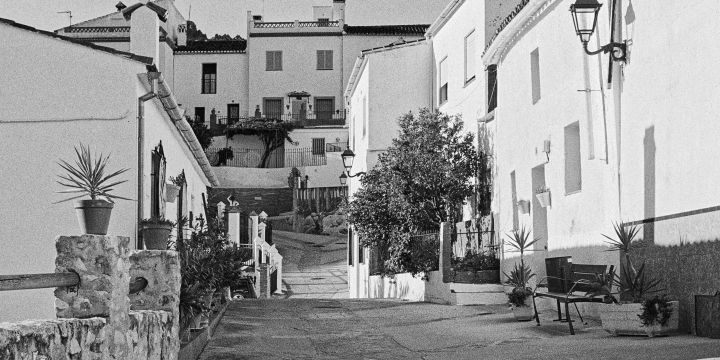
Cartajima’s most striking landmark is the Church of Nuestra Señora del Rosario, a 16th-century temple that stands at the highest point of the town and offers both historical interest and lovely views. The church’s high location and the surrounding narrow streets make it very difficult to photograph, so, unfortunately, I do not have any photos of the church. The following photos were taken in the adjacent streets.

Camera: Nikon F, Lens: Nikkor f2.8 28mm, Exposure: 1/125 sec, Aperture: f8, GPS location

Camera: Nikon F, Lens: Nikkor f2.8 28mm, Exposure: 1/125 sec, Aperture: f11, GPS location

Camera: Nikon F, Lens: Nikkor f2.8 28mm, Exposure: 1/125 sec, Aperture: f11, GPS location

Camera: Nikon F, Lens: Nikkor f2.8 28mm, Exposure: 1/250 sec, Aperture: f11, GPS location
Wandering through the village’s narrow, winding streets reveals a delightful blend of traditional Andalusian architecture and charming murals celebrating local culture and identity.
The following photos are of some of the murals I came across, interspersed with general photos of the lower part of the village.

Camera: Nikon F, Lens: Nikkor f2.8 28mm, Exposure: 1/125 sec, Aperture: f8, GPS location

Camera: Nikon F, Lens: Nikkor f2.8 28mm, Exposure: 1/125 sec, Aperture: f11, GPS location

Camera: Nikon F, Lens: Nikkor f2.8 28mm, Exposure: 1/250 sec, Aperture: f11, GPS location

Camera: Nikon F, Lens: Nikkor f2.8 28mm, Exposure: 1/250 sec, Aperture: f11, GPS location

Camera: Nikon F, Lens: Nikkor f2.8 28mm, Exposure: 1/125 sec, Aperture: f8, GPS location


Camera: Nikon F, Lens: Nikkor f2.8 28mm, Exposure: 1/250 sec, Aperture: f8, GPS location


Camera: Nikon F, Lens: Nikkor f2.8 28mm, Exposure: 1/125 sec, Aperture: f8, GPS location
Just beyond the village, the extraordinary Los Riscos de Cartajima – fascinating limestone formations sculpted by time – create a stunning natural backdrop. Hikers and photographers alike are drawn to this impressive sight. Unfortunately, I did not have time to explore this.
Nature, Trails, and Gastronomy
Surrounded by forests of chestnuts, cork oaks, and holm oaks, Cartajima is particularly beautiful in autumn, when the Valle del Genal becomes known as the “Bosque de Cobre” or Copper Forest due to the rich reds and golds of the seasonal foliage.

Camera: Mamiya M645 1000S, Lens: Mamiya Sekor f2.8 80mm, Exposure: 1/15 sec, Aperture: f8, GPS location
Residents of Cartajima claim the chestnut tree in the photograph, known as Castaño Arenas, is around 300 years old. Standing 17 metres tall and boasting a circumference of over seven metres, it’s situated beside the dirt track, Camino del Molino Real, which leads to Igualeja. This magnificent tree has become a beloved landmark and gathering spot for locals and travellers alike.
An interesting fact: The tree takes its name from its former owner. Curiously, it’s the custom in Cartajima to bequeath or sell the trees separately from the ground in which they’ve grown.
Outdoor enthusiasts will find numerous walking and hiking routes that explore this varied landscape. The local gastronomy is equally enticing, with hearty regional dishes featuring chestnuts, rabbit stews, and traditional fare like sopas refritas and locally produced mosto (young wine).
Festivals and Traditions
Cartajima’s calendar is filled with vibrant celebrations that unite the community.
Mid-August sees the Feria de Cartajima, a joyous festival honouring the Virgen del Rosario. Music, processions and festivities animate the village streets.
During Semana Santa, visitors are captivated by the unique ritual of Las Cortesías, a symbolic and heartfelt tradition.
Autumn brings regional food festivals celebrating the chestnut harvest. Visitors can sample seasonal dishes and experience local hospitality.
Film Photo Details
For most of the photos, I used a Nikon F film camera, loaded with HP5 film, pulled one stop (i.e. rated at 200 ISO). For the olive tree photo, I used a Mamiya M645 1000S camera and Kentmere film. Details of the camera, lens and settings are given under each photo.
I developed the film in Spur Acurol-N, 1+70, for 9 minutes @20C.
The photos were digitised using a Nikon Zf mirrorless digital camera with a Tokina AT-X Pro Macro 100mm f2.8 D lens and processed using DXO Photolab 8 software.
Film roll Nos. 461 and 464.