
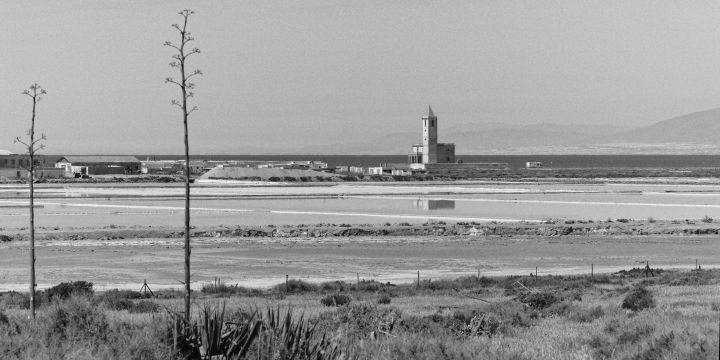
The Salinas de Cabo de Gata (Almeria) are a natural wetland system within the Cabo de Gata-Níjar National Park. These economically exploited salt flats lie between the small fishing town of Cabo de Gata and La Fabriquilla on Spain’s southeastern coast. Stretching along the Mediterranean shoreline, they create one of the region’s most recognisable landscapes.
The atmosphere around Las Salinas is tranquil and untouched. A road and walking paths run alongside the ponds, linking the town to nearby beaches and viewpoints. One side offers the calm waters and fishing boats of Cabo de Gata village, while the other features dunes, salt pools and distant volcanic hills. The Las Salinas Church and the nearby old defensive tower (Torreón De San Miguel De Cabo de Gata) overlooking the coast add historical charm. Together, these elements transform Las Salinas from an industrial landscape into one of the most peaceful and visually striking corners of the Almería coastline.
The Salt Flats
The Salt Flats are remarkably flat and open, featuring shallow pools separated by narrow embankments. These create mirror-like reflections that shift in colour throughout the day. Sunrise and sunset are particularly magical, with the salinas bathed in shades of pink, gold and silver, giving the landscape a surreal quality.

Camera: Mamiya M645 1000S, Lens: Mamiya Sekor f2.8 80mm, 1/250 sec, f11, GPS location
Las Salinas have been a hub for salt production for centuries, capitalising on the Almería coast’s intense sun and dry climate. Seawater is channelled into evaporation ponds where it gradually evaporates, leaving behind crystallised salt. While production has declined since its peak, salt extraction continues and remains a vital part of local identity. The white salt mounds near the ponds are a familiar sight for anyone driving along Cabo de Gata.

Camera: Mamiya M645 1000S, Lens: Sekor C 1:2.8 80mm, 1/250 sec, f11, GPS location

Camera: Mamiya M645 1000S, Lens: Mamiya Sekor f2.8 80mm, 1/250 sec, f11, GPS location
The Salt Workers’ Village
Adjacent to Salinas de Cabo de Gata lies the old salt workers’ village, locally known as the Poblado Salinero or simply “Las Salinas”. Built around 1907, during a dramatic expansion of industrial salt production along this coast, the salt company established a self-contained settlement for labourers and their families.
Today, much of the old village remains, with some buildings still inhabited and others restored. Its distinctive linear layout, alongside the salt flats and the sea, endures. The architecture is simple and functional, shaped by wind, salt and sun rather than tourism. Nearby landmarks like the church, old salt warehouses and the long embankments of the ponds maintain the atmosphere of a working industrial landscape.
I was particularly drawn to capturing the Poblado Salinero on film. I wanted to use Bergger Pancro 400 film, believing its gritty character would complement the simple architecture and harsh, barren environment. These are the photos I took:

Camera: Mamiya M645 1000S, Lens: Mamiya Sekor f2.8 80mm, 1/125 sec, f5.6, GPS location


Camera: KMZ Zorki 4, Lens: 12, 1/250 sec, f11, GPS location


Camera: KMZ Zorki 4, Lens: Jupiter 12, 1/250 sec, f11, GPS location


Camera: Mamiya M645 1000S, Lens: Mamiya Sekor f2.8 80mm, 1/500 sec, f11, GPS location


Camera: Mamiya M645 1000S, Lens: Mamiya Sekor f2.8 80mm, 1/60 sec, f11, GPS location


Las Salinas Church
Iglesia de las Salinas (also known as Iglesia de la Almadraba de Monteleva or Iglesia de San Miguel) is one of the most recognisable buildings beside in the old salt workers’ settlement. Officially dedicated to San Miguel, the small church was constructed during the early 20th century as part of the company village created for workers employed in the salt industry.

Camera: Mamiya M645 1000S, Lens: Mamiya Sekor C f2.8 55mm, 1/250 sec, f11, GPS location
Architecturally, the church is very simple and characteristic of the practical style found throughout Cabo de Gata. Its whitewashed walls, clean geometric lines, and modest bell tower reflect the austere environment of the region. Rather than ornate decoration, the building’s beauty comes from its setting: the church stands between the salt ponds, dunes, and sea, with volcanic hills rising in the distance. Because the surrounding landscape is so open and flat, the church becomes a striking landmark visible from far across the salinas.

Camera: Mamiya M645 1000S, Lens: Mamiya Sekor f2.8 80mm, 1/125 sec, f11, GPS location
Las Salinas Nature Reserve
Las Salinas Nature Reserve is a protected area that preserves the unique landscape of the Salt Flats. It offers visitors a chance to explore the natural beauty and ecological significance of this remarkable region.
Las Salinas’s defining feature is its wildlife. The shallow wetlands draw large numbers of birds year-round, making it a top spot for birdwatching in Cabo de Gata-Níjar Natural Park. Flamingos are the most famous visitors, often seen feeding in the lagoons, sometimes in surprisingly large groups. Depending on the season, visitors might also spot avocets, stilts, herons and migratory seabirds. These wetlands, set against the otherwise dry and desert-like landscape, provide a vital ecological refuge along the coast.

Camera: Mamiya M645 1000S, Lens: Mamiya Sekor f2.8 80mm, 1/1000 sec, f11, GPS location
Film Photo Details
I’ve visited Las Salinas de Cabo de Gata many times. This unique area offers a blend of scenic coastline, nature, history, tranquillity and even an industrial side from the salt works. During my latest trip, I decided to capture its distinctive character on black-and-white film.
Most of the photos were taken in April 2026 using a Mamiya M645 1000S camera and either Bergger Pancro 400 film (rated at 200 ISO) or Ilford FP4. Some of the photos are from previous visits and were taken with a KMZ Zorki 4 film camera. Details of the camera, lens and settings are given under each photo.
I developed the film I shot this year in 510-Pyro, diluted 1+100.
The photos were digitised using a Nikon Zf mirrorless digital camera with a Tokina AT-X Pro Macro 100mm f2.8 D lens and processed using DXO Photolab 8 software.
Film roll Nos. 215, 281, 483 and 485.