
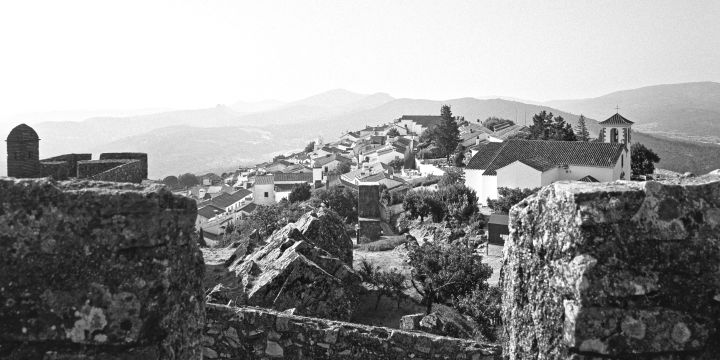
In this post, we go on a photo walk around Marvão, a stunning medieval village perched high on a quartzite crag in the Alentejo region of Portugal. We explore the castle, which sits at the highest point of the village, the 13th-century walls, the whitewashed houses and learn a little about the rich history that stretches back long before the Roman era.
Introduction
Perched dramatically above the Alentejo plains, the fortified village of Marvão has stood as a timeless sentinel on the Portuguese-Spanish border for centuries. Its rich history began in the 9th century when the Muwallad rebel Ibn Marwan first built a castle on this commanding site. Later, the Knights Hospitaller and the Portuguese crown heavily fortified the village, making it a critical defensive outpost against Spanish forces.
Today, this incredible history blends beautifully with a peaceful, welcoming atmosphere. The ancient stone walls now protect a quiet, beautifully preserved village filled with narrow, cobbled streets and whitewashed houses.
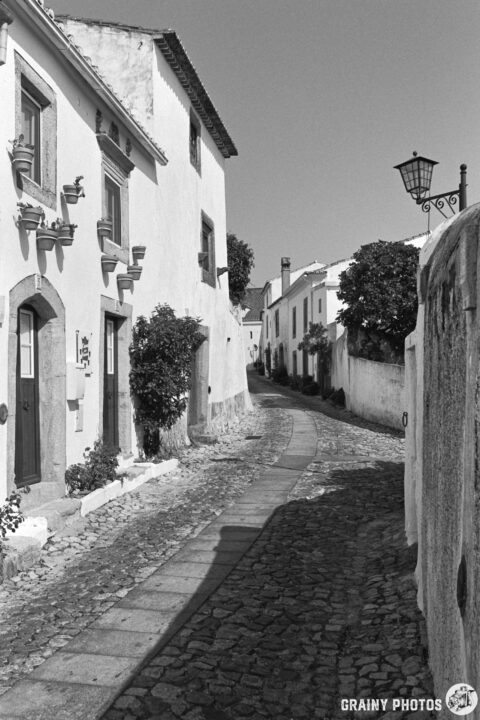
Camera: Nikon F3, Lens: 35mm f2, Exposure: 84215/21053749 sec, Aperture: f11, GPS location
Photography in Marvão
For photography enthusiasts, Marvão is an amazing location. With its 14th-century granite castle, medieval walls, pretty village houses and its location within the beautiful Serra de São Mamede Natural Park, you are spoilt for choice. Photographs beg to be taken everywhere. If you like Marvão, I also recommend Castelo de Vide, just a short distance away. Also, just a few minutes’ drive down the mountain, you’ll find Cidade Romana de Ammaia, the fascinating ruins of a 1st-century Roman town that once thrived in the valley.
I was there in August, and because of the high temperatures (over 40 C), I went very early. This turned out to be a great decision because of a light early-morning mist, and, also, I got lucky at the castle; more about that later…
Film Photo Details
For this photo walk, I used the Nikon F3, probably my favourite film SLR camera. I used it with several prime lenses; details are under each photo. The Nikon F3 is widely regarded as the best professional reporters’ camera of its era. It dominated the market from the 1980s through the early 2000s.
Film: Ilford Delta 100 (rated at box speed)
Development: Perceptol (1+1) for 17 minutes at 20°C
Digitisation: Nikon Zf with a Tokina AT-X Pro Macro 100mm lens
Processing: DXO PhotoLab 8
Film roll No. ID: 503
The Medieval Walls
The 13th-century stone walls, up to 10 feet thick, completely enclose the entire village, serving as a defensive perimeter that integrates the town into a single fortress. Access to the village is restricted to two main entrances located within these walls: Porta de Rodão and Porta Este.
Walking the loop around the village perimeter provides dramatic clifftop drops and views over the surrounding Serra de São Mamede Natural Park and cork-oak forests.

Camera: Nikon F3, Lens: 35mm f2, Exposure: 1/500 sec, Aperture: f11, GPS location
The Village
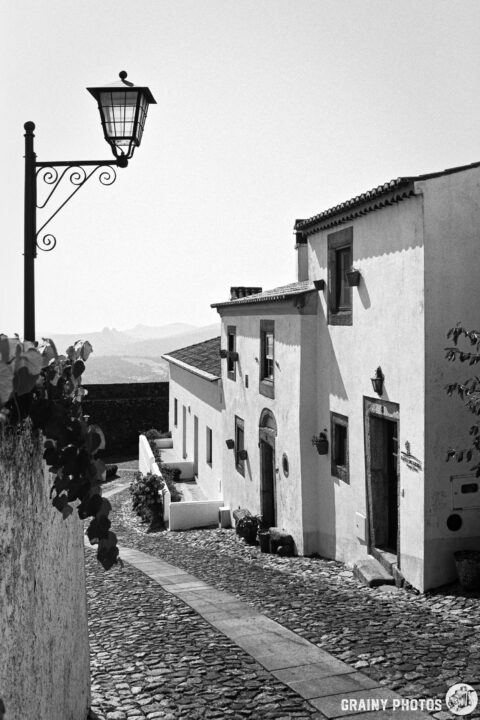
The houses in Marvão are a beautiful and distinct example of traditional Alentejo architecture. The local granite is the primary building material, visible in the exposed stone frames that contrast sharply with the brilliant whitewashed façades. Lime wash was traditionally used to reflect the intense Alentejo sun and for its natural antibacterial properties.
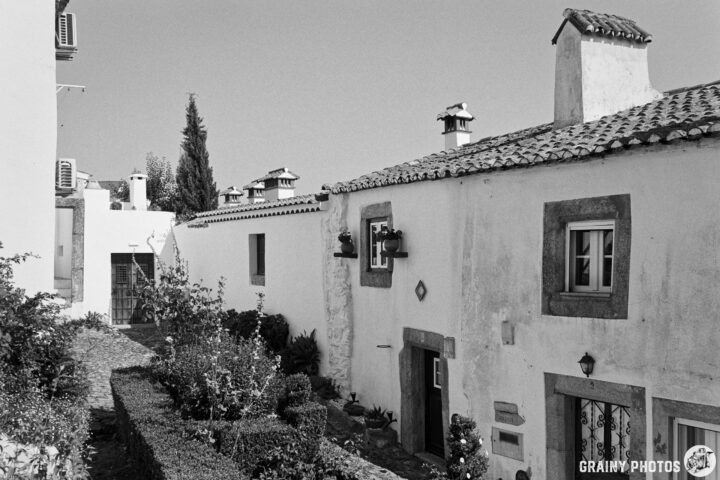
Lens: 35mm f2, Exposure: 1/125 sec, Aperture: f8, GPS location
Architecturally, the village is a remarkably preserved blend of Gothic and Manueline styles, with many of the stone homes dating back to the 14th and 16th centuries.
As we head uphill towards the castle, undoubtedly the jewel of Marvão, we explore the narrow cobbled streets and whitewashed houses, breathing in the history and the atmosphere. I took the following photos on the way:
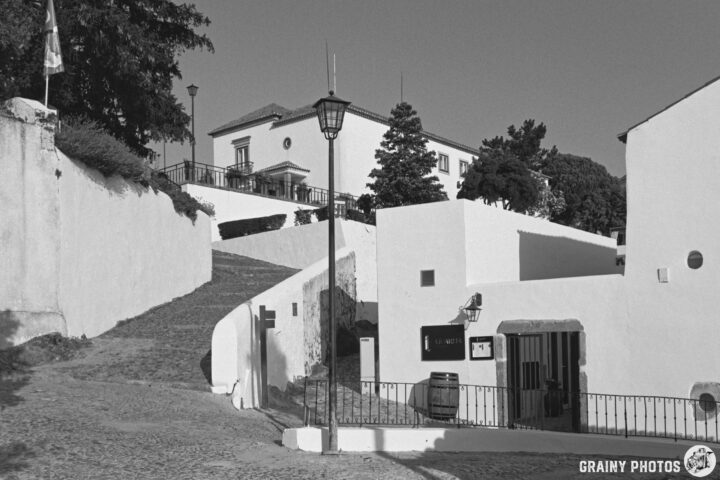

Lens: 35mm f2, Exposure: 1/125 sec, Aperture: f8, GPS location
As we wind through the narrow cobblestone streets, it is amazing to see that the entire village is contained within the medieval walls. Because space inside is highly limited, domestic and military architecture merge completely; many of the houses lean directly against the 13th-century stone ramparts, forming part of the village’s outer elevation.

There are very few cars in the village, as there is simply no space to park. Residents leave their cars in the parking lots outside the city walls, and tourists are not allowed to drive inside. The place looks as though it hasn’t changed for hundreds of years—it’s like stepping into a time warp.
Churches
The Holy Spirit Church (Igreja do Espírito Santo) was founded in 1573 as a house of assistance tied to the charitable works of the Portuguese Misericórdia (Mercy). Its most famous feature is the stunning granite portal carved in the Renaissance style—which is actually a unique architectural example in Marvão, where Gothic and Manueline styles usually dominate.
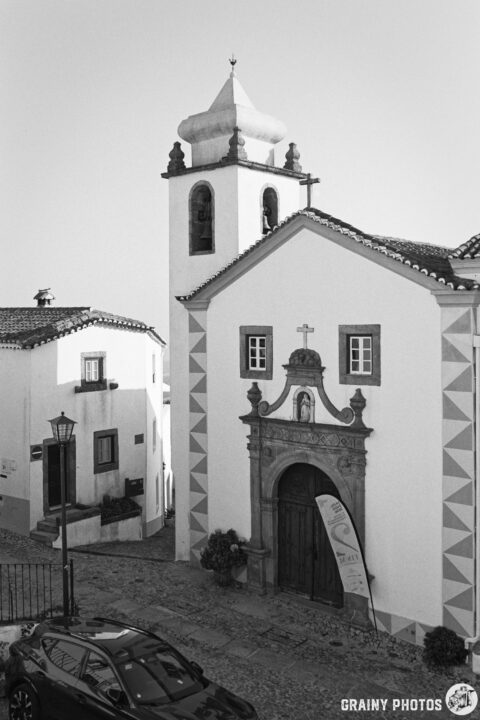
Another famous 13th-century church, Igreja de Santa Maria, has been repurposed and now houses the local Municipal Museum, where you can view regional archaeological finds, medieval armour, and religious artworks.
Lens: 35mm f2, Exposure: 1/125 sec, Aperture: f8, GPS location
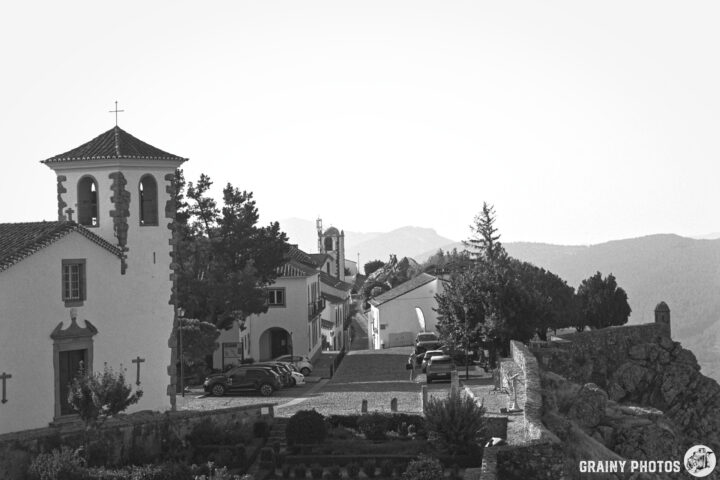
We are now on the final approach to Marvão Castle. We turn around and look back along Rua do Castelo. The view is breathtaking; this is pure history. Everything shimmers in the early morning light and gentle mist, which softens the mountainous backdrop.

Lens: 85mm f2, Exposure: 1/125 sec, Aperture: f8, GPS location
Marvão Castle
When you visit Marvão, the main draw is the 14th-century granite Castelo de Marvão itself, a masterpiece of medieval engineering with a towering keep and a massive functional cistern. The castle and fortifications seen today were largely expanded under King Denis in the late 13th century, strengthening Marvão’s role as an impenetrable stronghold.

Lens: 35mm f2, Exposure: 1/125 sec, Aperture: f8, GPS location
When I got to the castle, the ticket office was closed (as I mentioned before, I was in Marvão early to avoid the heat of the day). Fortunately for me, there was a cleaning lady who took pity on me (I must have looked so disappointed). She unhooked the chain and waved me through. Result! I had the whole castle grounds to myself! I took these photos:


Walking the intact medieval castle ramparts offers an unforgettable experience and perspective of the Serra de São Mamede Natural Park below. I took these three photos:

Lens: 35mm f2, Exposure: 1/60 sec, Aperture: f8, GPS location

Lens: 28mm f2.8, Exposure: 84215/21053749 sec, Aperture: f8, GPS location

Lens: 28mm f2.8, Exposure: 1/125 sec, Aperture: f11, GPS location
The grounds within the castle complex are spacious and open. This was for a reason; they were designed to aid in the sheltering and assembly of villagers and troops during a siege. There was also a large rain-collecting cistern, which allowed the castle to safely harbour the local population and military forces while withstanding prolonged attacks.

Lens: 35mm f2, Exposure: 1/125 sec, Aperture: f8, GPS location

Lens: 35mm f2, Exposure: 1/125 sec, Aperture: f11, GPS location

Conclusion
Marvão rewards the slow traveller. Its true magic lies not only in the ancient castle or the quiet, cobbled streets, but in the rare atmosphere where the echoes of the past meet the warmth of modern Portuguese hospitality.
Its wonderful history and welcoming atmosphere will stay with you long after you leave.