

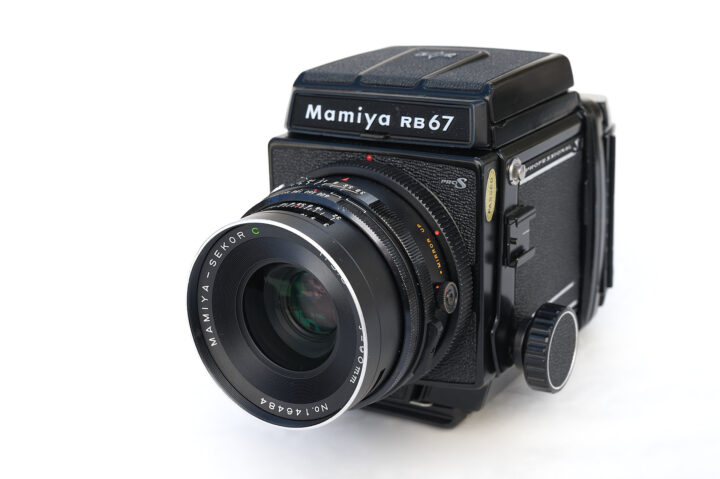
The Mamiya RB67 is a legendary medium-format film camera that has gained immense popularity among professional photographers and enthusiasts since its introduction in 1970. The “RB” stands for “Rotating Back”.
The Mamiya RB67 was my first 120-film camera and my introduction to medium-format photography.
History
The RB67 was a fully mechanical camera. Three versions were made: the RB67 Pro, the RB67 Pro-S and the RB67 Pro-SD. Production of the RB67 Pro started in 1970. The Pro-S model came out in 1974 with a modified focusing screen, which indicated the orientation of the back (i.e. landscape or portrait) by red lines. The final model, the Pro-SD, was released in 1990.
The successor to the RB67 was the RZ67, released in 1982. The biggest difference is that the RB67 is completely mechanical, while the RZ67 has an electronic shutter; it is able to transmit exposure information via electronic couplings. In addition, the RZ67 has a plastic exterior body, which makes it somewhat lighter.
The main features of the Mamiya RB67
The RB67 utilises 120 and 220 roll film, producing large 6×7 cm negatives; 6×8 cm and 6×4.5 cm negatives can also be shot by using optional film backs. Compared to 35mm film cameras, this larger negative size provides higher image quality and detail, making it a favourite for studio work, portrait photography, and landscape photography.
The RB67 is built like a tank, with a sturdy metal construction that exudes durability and reliability. The camera’s large size and weight may not make it the most portable option, but its ergonomics and handling are well-regarded among photographers who appreciate its solid feel and intuitive controls. It was particularly well-suited for professional use in studios.
Rotating back
The RB67 is renowned for its unique rotating back mechanism, which allows photographers to quickly switch between landscape and portrait orientations without having to turn the entire camera. This feature is convenient for studio photographers who need to maintain consistent framing while changing compositions.

Modular design
One of the standout features of the RB67 is its modular design. The camera body consists of three main components: the body itself, the lens, and the film back. This modularity allows photographers to interchange lenses, film backs, viewfinders, and other accessories to suit different shooting requirements.

Mamiya made many accessories for the RB67, including six focusing screens, waist-level finders, prisms, magnifying hoods and grips for the camera.
Lenses
Mamiya offered a range of high-quality lenses for the RB67 system, including wide-angle, standard, and telephoto options. These lenses are renowned for their exceptional optical quality and sharpness, making them highly sought after by photographers seeking the best image quality possible.
There is no shutter in the RB67; the Sekor lenses have built-in mechanical leaf shutters, which are cocked by a lever on the side of the camera body (see photo below). This is independent of the film advance, which is by a separate advance lever on the top of the film back.
Focusing and handling
The RB67 features a bellows focusing system, which allows for precise manual focusing by extending or retracting the bellows. While this can take some getting used to, especially for those accustomed to more modern autofocus systems, it provides ultimate control over focus and depth of field.
One of the problems of a bellows focusing system is light fall-off due to the extension of the bellows when focusing at closer distances. Mamiya addressed this by utilising a graph on the side of the camera, which was revealed as the bellows extension increased. The graph had curves for the Mamiya lenses, and you read off the necessary corrections and applied them manually to the camera settings.

The camera’s large size and weight may not make it the most portable option, but its ergonomics and handling are well-regarded among photographers who appreciate its solid feel and intuitive controls.
Conclusions
Despite being a film camera introduced over five decades ago, the Mamiya RB67 continues to be cherished by photographers for its reliability and solid build, exceptional image quality, versatility, and timeless design. Its modular concept and robust build have influenced numerous medium format camera systems that followed, and many photographers still cherish the RB67 for its unparalleled performance and enduring appeal.
It is one of my favourite medium-format cameras. Its only disadvantage, as far as I’m concerned, is its size and weight. I prefer to take the Mamiya M645, which is much smaller and lighter, for long treks.
Sample Photos

Camera: RB67, Lens: Mamiya Sekor C 180 mm, Exposure: 1/400 sec, f11, GPS location


