
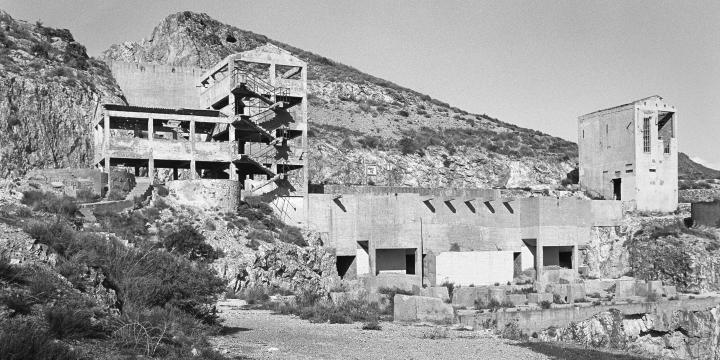
Rodalquilar’s geological heritage is not limited to gold but also includes other minerals such as silver, lead, zinc, alunite, and the locally named mineral rodalquilarite. Today, the abandoned infrastructure, including tunnels, processing plant ruins, and miner housing, stands in ruins, serving as a striking industrial relic of the past.
I discovered the Abandoned Gold Mines of Rodalquilar (Níjar, province of Almería, Spain) several years ago. This fascinating place boasts stark industrial architecture and is well worth visiting and exploring.
In this article, I’ve summarised the mining history of the area, the extracted minerals, and the operational periods of the mines. I’ve also included 26 photographs of the landscape and ruins of both the mine works and the housing. All the images were shot on film; find out more about how I took the photos.
The History of Mining in Rodalquilar
Rodalquilar has been an object of great interest for the extraction of alkaline sulphates since the Middle Ages, possibly even since the Roman occupation of the Iberian Peninsula. These sulphates were essential for the textile industry and the tanning of skins. In the 19th century, metal mining for lead, zinc, and silver began.
The Rodalquilar mining area lies within a volcanic caldera where hydrothermal fluids once deposited gold along with other metals and minerals in fissures of the igneous rocks.

Camera: Nikon F3, Lens: Nikkor f2 35mm, Exposure: 1/125 sec, Aperture: f11, GPS location

Camera: Nikon F3, Lens: Nikkor f2 35mm, Exposure: 1/125 sec, Aperture: f8, GPS location
The Rodalquilar Gold Mines
Gold was first discovered in Rodalquilar in 1883 when gold was found in the Las Niñas mine in the Barranco del Lobo area, just south of the village. This discovery sparked significant interest in gold mining and led to the “gold rush” in the area. Although people had suspected gold’s presence in the rocks earlier in 1864, it wasn’t until 1883 that the discovery was officially reported and mining activity began.
Initially, the gold was not economically attractive because it occurred in low concentrations mixed with other metals like lead and silver, and the hard silica-rich rock made extraction difficult. Early mining throughout the late 19th century was small-scale, with ore carried by hand and donkey carts to the coast for processing elsewhere.
During the early 20th century, greater efforts were made. In 1915, more gold was discovered in the “Maria Josefa” mine, and newly available technology enabled the construction of a gold extraction plant at Cortijo El Estanquillo nearby. This plant also served the mines of “Las Niñas”, “Ronda” and “Consulta”.
In 1929–1930, foreign companies, including German and then British, invested in mechanised extraction technologies such as tracks, drilling equipment, and cyanide treatment plants. The British-owned Minas de Rodalquilar S.A. introduced more modern methods and increased output, becoming relatively successful before the Spanish Civil War (1936–1939) disrupted operations. After the war, the mines were nationalised and modernised further.
Mining in the area reached its peak in the 1950s and early 1960s.
The Denver Plant
In May 1956, General Franco inaugurated a new smelting facility known as the ‘Denver’. This plant stood as the largest gold mine of its kind in Western Europe. By the conclusion of the 1950s, the facility employed a workforce of 1,000 individuals and accommodated 1,400 villagers, who lived in the nearby village directly tied to mining.

Camera: Nikon F3, Lens: Nikkor f2 35mm, Exposure: 1/250 sec, Aperture: f8, GPS location

Camera: Mamiya C220, Lens: Mamiya Sekor 3.5 65mm, Exposure: 1/500 sec, Aperture: f11, GPS location

Camera: Mamiya C220, Lens: Mamiya Sekor 3.5 65mm, Exposure: 1/125 sec, Aperture: f11, GPS location


In the 1950s and 60s, the region’s annual gold production was substantial, with several hundred kilograms extracted annually. The gold exploitation in Rodalquilar resulted in a cumulative production of seven tons, primarily from Cerro del Cinto. The origin of these mineralisations can be attributed to the interaction of hydrothermal fluids with volcanic rocks, leading to significant alterations in the rocks. Rodalquilar’s exceptional exposure of both makes it a global example for studying gold deposits with high sulphurisation.
The Mining Decline
Despite the peak production, the economic viability of gold mining declined due to several factors. Firstly, the ore’s gold concentration was relatively low, often only a few grams per tonne. Secondly, the accessible deposits were exhausted, leaving the mines unviable. Consequently, the main mines and Denver processing plant were closed in 1966 when the available ore was largely depleted. The machinery was relocated to other locations or disposed of for sale.
A brief attempt at modern extraction was made in 1989-1990 using new technology. However, high global production elsewhere and the designation of the area as part of Cabo de Gata-Níjar Natural Park made further large-scale mining unviable. Consequently, operations ceased permanently.
The Miners’ Village
At the entrance to Rodalquilar, the abandoned remains of the miners’ village offer a glimpse into the past. Visitors can explore these ruins and see the remnants of a once-thriving, yet isolated, community. While some areas are fenced off, the abandoned workers’ houses, social halls, and schools provide a poignant reminder of the boomtown that once was. These low-slung cottages, built for a workforce of over a thousand during the 1950s and 60s, were largely abandoned to the elements after the mine closures in 1966, creating a haunting “ghost village.”
Many structures in Rodalquilar are in ruins, but the area has seen a partial, alternative second life. Some former managers’ houses have been converted into hotels, while others have been restored for holiday lets, with further restoration projects planned.

Camera: Nikon F3, Lens: Nikkor f2 35mm, Exposure: 1/125 sec, Aperture: f11, GPS location

Camera: Nikon F3, Lens: Nikkor f2 35mm, Exposure: 1/250 sec, Aperture: f11, GPS location

Camera: Nikon F3, Lens: Nikkor f2 35mm, Exposure: 1/250 sec, Aperture: f11, GPS location


Camera: Nikon F3, Lens: Nikkor f2 35mm, Exposure: 1/60 sec, Aperture: f11, GPS location


Camera: Nikon F3, Lens: Nikkor f2 35mm, Exposure: 1/125 sec, Aperture: f5.6, GPS location
Visiting the Rodalquilar Gold Mines
The mine ruins are open to the public, with road signs directing visitors to the top of the village. There’s a museum and coffee shop, but opening times vary.
The ruins are mostly accessible, and you’re free to wander and explore. The only notable exception is the main abandoned miners’ workers’ village, which is fenced off and you pass as you drive into the town. The entrances to the mines themselves are sealed. The stark architecture of the process plant is amazing.
There are also several walks into the countryside and Cerro del Cinto that take you past further mining ruins. I took a short 4.5 km walk (Wikiloc – Minas de Rodalquilar walk) and took the following photos:

Camera: Nikon F3, Lens: Nikkor f2 35mm, Exposure: 1/60 sec, Aperture: f8, GPS location

Camera: Nikon F3, Lens: Nikkor f2 35mm, Exposure: 1/250 sec, Aperture: f11, GPS location

Camera: Nikon F3, Lens: Nikkor f2 35mm, Exposure: 1/125 sec, Aperture: f8, GPS location
Film Photo Details
I used a Nikon F3 and Mamiya C220 film cameras, both loaded with Kentmere 100 film. Details of the camera, lens and settings are given under each photo.
I developed the film in Spur Acurol-N, 1+70, for 9 minutes @20C.
The photos were digitised using a Nikon Zf mirrorless digital camera with a Tokina AT-X Pro Macro 100mm f2.8 D lens and processed using DXO Photolab 8 software. I used Pixelshift (16 images) to obtain higher resolution scans of the Mamiya C229 photos.
Film roll No. 475, 476 and 477.